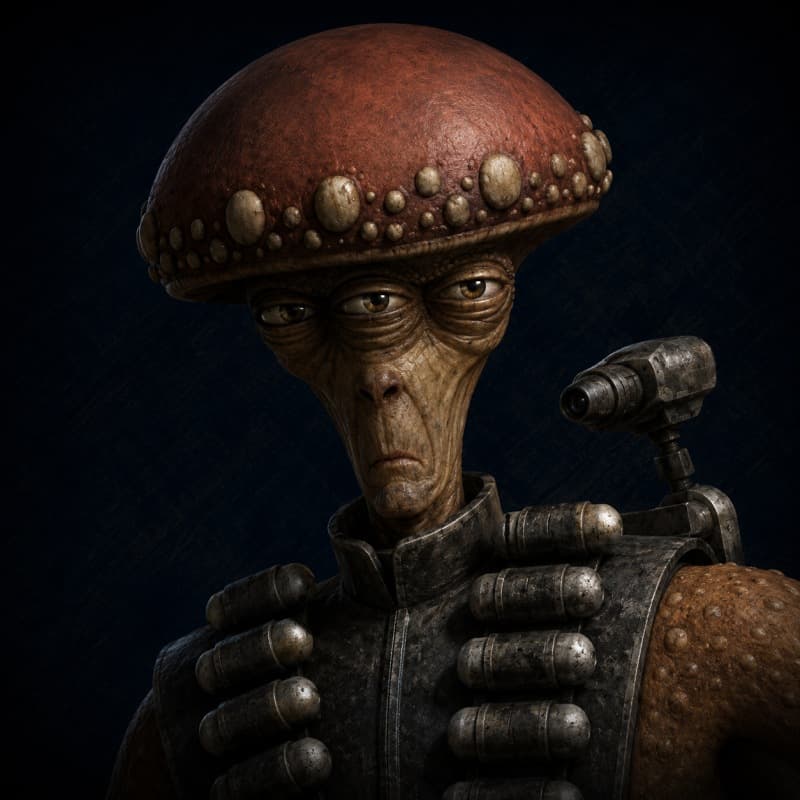
Parwan
Derrown, the Clone Wars bounty hunter Count Dooku rated among the best in the galaxy, was a Parwan, and his species' signature shows in the nickname he earned: the Exterminator, for the killing electric shocks he delivered through his tendrils.
Home world: Parwa
- Size
- Medium
- Speed
- 30 ft
- Height
- 1.6 to 1.8 meters
- Weight
- Lighter than a typical humanoid of similar size due to gas-filled internal structures
- Adulthood
- 50 standard years
Traits
Natural Hovering
You hover a few feet off the ground. You ignore difficult terrain and have Advantage on checks to avoid falling prone.
Gentle Drift
You move fluidly in three dimensions. You gain Advantage on Dexterity saving throws.
Bioelectric Tendrils
Your tentacle-limbs crackle with bioelectric current. You have a natural melee weapon — your tendrils — that deals 1d8 Electric damage, and you may use your Dexterity modifier instead of Strength for its attack roll.
Frail Physiology
Your body cannot handle blunt trauma. You take +2 additional damage from bludgeoning attacks.
Fire Vulnerability
Your gas sacs are highly flammable. You have Vulnerability to Heat damage.
Distracting Glow
Your bioluminescence can give away your position. You have Disadvantage on Stealth checks.
Lore
Derrown, the Clone Wars bounty hunter Count Dooku rated among the best in the galaxy, was a Parwan, and his species' signature shows in the nickname he earned: the Exterminator, for the killing electric shocks he delivered through his tendrils. Parwans are a sentient species whose bodies are, quite literally, ambulatory bags of gas, so light that they drift rather than walk and crackle with a natural electrical charge that makes them both unsettling to stand near and very hard to kill by conventional means.
A Parwan is tall and gangly, its torso a buoyant sac that holds it aloft on wind currents while four long tentacle-like appendages dangle below where most species keep legs. Two arms end in three-fingered hands, and the head is a strange mushroom-shaped crown set with three eyes. The skin runs to a pale light brown. Because the body is lighter than air, a Parwan does not so much stand as tether itself, using those lower tentacles and its arms to anchor against the ground or a perch so the breeze does not carry it off. The whole creature produces a high electrical field and visibly crackles with the energy it generates, which lets it shrug off electric currents and harsh liquids that would harm most other beings.
Their homeworld is Parwa, a planet whose seasons run for several centuries rather than months. That glacial calendar is written into Parwan biology: they are extremely long-lived, and they pass through periods of hibernation as a normal part of their life cycle, sometimes dropping into that dormancy even when they are far from Parwa and the planet's slow turning has no direct hold on them.
Parwans keep their own language, which to anyone who does not speak it sounds like gibberish, and some members lean on it in preference to Basic even when dealing with outsiders. Between the unblinking three-eyed stare, the constant low crackle of electricity, the floating gait, and a tongue that resists translation, a Parwan abroad in the wider galaxy tends to read as deeply alien to the species around it.
The two Parwans the galaxy remembers sit at opposite poles. Centuries before the Clone Wars, in the High Republic era, Jedi Master Obratuk Glii served the Order as a respected diplomat, sent to negotiate with the Hutts on Nal Hutta until his own seasonal hibernation took him just before arrival and forced his Padawan Farzala Tarabal to lead the talks alone. Over a lifetime that ran past a thousand years he trained many apprentices and built a lightsaber in honor of each, wielding five at once in tribute to them all (his Parwan physiology made him well suited to fighting with multiple blades), before he was captured by Marchion Ro and killed aboard the Gaze Electric. Derrown took the species' gifts in a darker direction: invited to compete in Moralo Eval's lethal proving ground, the Box, he injected an electrified serum that would have killed any other contestant and walked straight through a ray shield his charged body could survive, then shut down the trap from the far side.
For a SWURPG player, a Parwan is built around lift, not muscle. The Natural Hovering and Gentle Drift traits put that lighter-than-air body on the table directly, letting you ride the air and settle down softly, while the +2 Dexterity captures a creature that lives by deft, drifting control of its own position. The cost is fragility: the gas-bag frame brings a -2 Constitution along with Frail Physiology, and that same flammable, buoyant body makes Fire Vulnerability an easy read. Distracting Glow leans into the constant crackle of electrical energy a Parwan throws off, hard to hide and hard to ignore in a tense room. Play a Parwan as the unsettling, oddly graceful outsider who floats above the firefight and would rather not be hit at all, because being hit goes badly.
Physical Description
Parwans possess elongated, tapering bodies that appear weightless, allowing them to hover and glide through the air. Their exoskeleton-like outer layer forms segmented plating reminiscent of insectoid or cephalopod anatomy, though no direct biological comparison exists in Canon or Legends. Their limbs are long and thin, branching into multiple dexterous appendages that can manipulate tools with surprising strength despite their light appearance. This build enables Parwans to balance effortlessly between floating drift and rapid directional shifts.
Their heads feature large, bulbous eyes capable of perceiving ultraviolet and electrical patterns within atmospheric fields—a necessity for survival on Parwa. Their mouths are narrow and often hidden beneath plated ridges, with vocal structures producing high-frequency sounds not easily interpreted by most humanoids without translation. Their bodies exhibit near-perfect electrical insulation, and Canon demonstrates that they can channel electrical energy without harm.
Parwans display the extraordinary ability to disperse their bodies into smaller, independently mobile components composed of energized matter. When recombined, their form appears seamless, suggesting cellular or sub-cellular cohesion not observed in most species. This ability is shown only in Canon during the Clone Wars and is not elaborated upon, but its consistency suggests an evolutionary connection to Parwa’s storm-charged environment rather than supernatural influence.
Their coloration ranges from muted purples and grays to pale blues, often reflecting faint bioluminescent glows when exposed to electrical charge. Their overall appearance is alien, graceful, and evocative of gaseous-world evolution.
Culture & Personality
Parwan personalities, based on limited Canon exposure, reflect pragmatism, caution, and a professional detachment suited to survival in hazardous environments. They tend to speak concisely, avoid unnecessary conflict, and prioritize efficiency, consistent with a species accustomed to constant atmospheric instability. Their cautious behavior is not distrust but a survival instinct honed on a world where environmental changes can be lethal.
Customs are not deeply documented, but reasonable, explicitly labeled speculation suggests Parwans may structure their societies around atmospheric patterns, forming floating communal clusters that shift position based on seasonal storm cycles. This conjecture aligns with environmental data from Parwa but remains speculative. Known behavior indicates that Parwans value independence and personal boundaries, possibly due to their need for controlled micro-atmospheres.
Their interactions with outsiders require careful atmospheric adaptation, translation support, and mutual patience. Parwans are capable collaborators but appear to avoid long-term entanglements unless aligned with personal objectives. Their sense of identity may be strongly tied to environmental freedom, explaining their discomfort in enclosed or low-altitude spaces.
In SWURPG stories, Parwan customs support characters who are highly specialized, resourceful, and unconventional. Their alien worldview and atmospheric heritage enrich narratives involving unique survival challenges, electrical hazards, or high-stakes infiltration missions.
Frequently Asked Questions
What is a Parwan in Star Wars?
Derrown, the Clone Wars bounty hunter Count Dooku rated among the best in the galaxy, was a Parwan, and his species' signature shows in the nickname he earned: the Exterminator, for the killing electric shocks he delivered through his tendrils. Parwans are a sentient species whose bodies are, quite literally, ambulatory bags of gas, so light that they drift rather than walk and crackle with a natural electrical charge that makes them both unsettling to stand near and very hard to kill by conventional means.
What are the Parwan ability score modifiers in SWURPG?
A Parwan character gains +2 Dexterity and -2 Constitution to their ability scores in SWURPG.
What species traits do Parwan characters have?
Parwan characters have 6 species traits: Natural Hovering, Gentle Drift, Bioelectric Tendrils, Frail Physiology, Fire Vulnerability, Distracting Glow.
Can I play a Parwan in SWURPG?
Yes — Parwan is a free, fully playable species in SWURPG, a fan-made Star Wars tabletop RPG. Pick it in the browser-based character builder and its ability modifiers and traits apply automatically.
What are some Parwan names?
Example Parwan names include Obratuk Glii, Derrown, Gubacher. Generate more original Parwan names with the SWURPG Star Wars name generator.