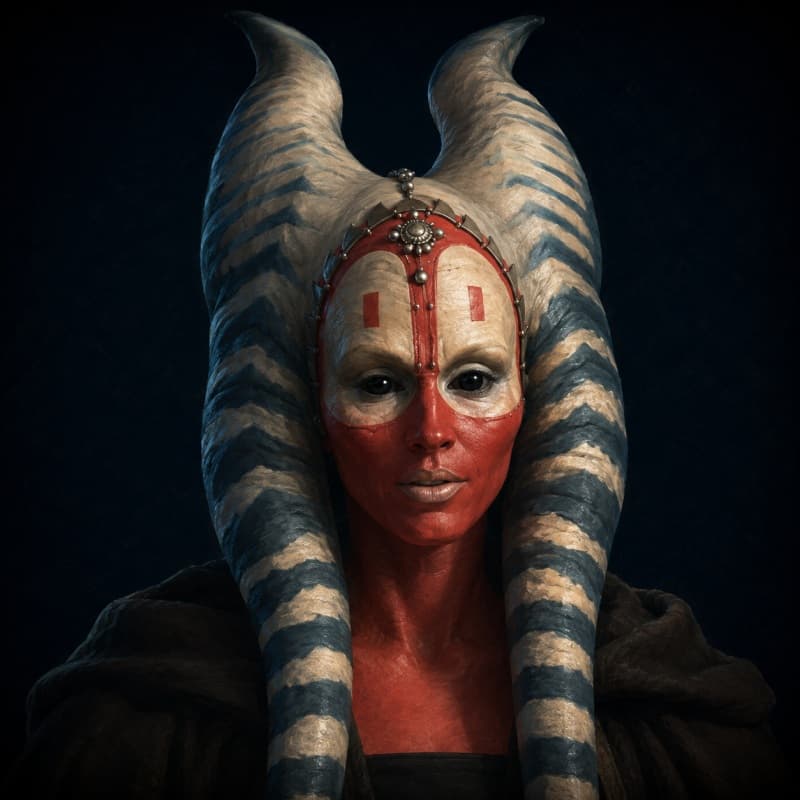
Togruta
Togruta are the red-and-white humanoids of Shili, marked by the cone-like horns and trailing head-tails that frame the galaxy's most famous example of the species: Ahsoka Tano, the former Jedi Padawan turned rebel who carried those montrals into three eras of war.
Home world: Shili, a world of forests, hidden valleys, and red-and-white turu-grass scrublands in the Expansion Region.
- Size
- Medium
- Speed
- 30 ft
- Height
- 1.7 meters
- Weight
- 75 kilograms
- Adulthood
- 18 standard years
Traits
Pack Coordination
When an ally is within 10 ft of you, you gain +1 to attack rolls on melee attacks against a creature adjacent to that ally. When no ally is within 20 ft, you take -1 on attack rolls due to instinctive discomfort with isolation.
Agile Acrobat
You have Advantage on Acrobatics checks.
Montral Awareness
Your hollow montrals passively sense movement and proximity through echolocation. You automatically sense the presence and rough location of any creature within 30 feet, even if it is unseen or in darkness, and you cannot be surprised by a creature within that range. This is spatial awareness, not sight: it does not let you target an unseen creature without the normal penalties, and it does not let you see in the dark.
Social Transparency
You have Disadvantage on Deception checks. Togruta struggle with lying.
Lore
Togruta are the red-and-white humanoids of Shili, marked by the cone-like horns and trailing head-tails that frame the galaxy's most famous example of the species: Ahsoka Tano, the former Jedi Padawan turned rebel who carried those montrals into three eras of war. Ask what a Togruta is and the answer starts at the head. Two hollow, horn-like montrals rise from the skull and three lekku, or head-tails, hang down past the shoulders. Those montrals are not decoration. They are a sense organ, and they let a Togruta feel the shape of a room and the movement of bodies within it without ever turning to look.
The montrals work by echolocation. They are hollow, and they read ultrasonic waves bouncing off nearby objects, giving a Togruta a quiet, passive map of proximity and motion out to roughly twenty-five meters. It is spatial awareness more than true sight, so it does not let them fight unerringly while blinded or in total darkness, though many train hard to close that gap. Alongside the montrals come the three head-tails, distinctive because most lekku-bearing species have two: a pair falling over the chest and a single thicker lek down the back. Montrals and lekku both grow until adulthood, with females tending toward longer lekku and males toward more branched montrals. The skin runs through oranges, reds, and yellows, broken by bold white facial markings, and the head-tails carry striped bands. (In Legends, that red-and-white patterning is described as inherited camouflage, a holdover from ancestors who slunk through Shili's red-and-white turu-grass to ambush prey.)
Shili sits in the Expansion Region, a world of meter-high scrubland grass and large, dangerous beasts, and the Togruta evolved as pack hunters under that pressure. Safety came from numbers. They banded into tribes to stand against predators like the akul and to encircle their own prey, using the montral sense to coordinate the closing ring without a sound. That ecology shaped the culture as much as the body. Togruta work well in large groups, and (In Legends) individualism was treated as something close to abnormal, an instinct to fall in with the pack that runs deep enough that standing apart reads as a deliberate, leaderly act rather than a default.
The hunting heritage still surfaces in custom. Togruta have sharp canine teeth, used to swiftly kill their traditional prey, the small thimiar, in a way that triggered post-mortem spasms and gave outsiders the false belief that the species was venomous; the Togruta rarely corrected the rumor and let the menace work for them. (In Legends) hunters wore the pelts and teeth of their kills as marks of maturity, with the greatest pride reserved for the tooth of an akul brought down alone, worn as an akul-tooth headdress. The montral sense and the pack reflex are the same trait seen from two angles: a body built to read space, attached to a mind built to read the group.
Within the Jedi Order the Togruta are best known through two figures. Shaak Ti served as a Jedi Master and member of the High Council during the Clone Wars, a calm and formidable combatant. Ahsoka Tano, apprenticed to Anakin Skywalker, became the more famous by far, growing from headstrong Padawan into a figure who walked away from the Order and kept fighting the Empire long after it fell. Their prominence has made the silhouette of montrals and head-tails one of the most recognizable in Star Wars, and a reliable shorthand for a Togruta whether or not they ever touched the Force.
As a player character, a Togruta in SWURPG leans into exactly the strengths the lore promises. The Pack Coordination trait turns the species' tribal-hunter instinct into a mechanical edge when fighting alongside allies, rewarding the encircle-and-coordinate style that defined them on Shili. Agile Acrobat reflects the lithe, predatory athleticism of a hunter built to slip through grass and close on prey. Social Transparency leans on the open, group-first psychology of a culture where reading the pack is second nature.
Physical Description
Togruta are tall, lithe humanoids most easily recognized by their colorful skin and elaborate head structures. Their skin tones range from deep red and orange to pale yellow or other warm hues, often broken up by striking white facial markings unique to each individual. These patterns extend across the body as stripes on the arms, legs, back, and torso, echoing the mottled tones of Shili’s turu-grass plains. Their lips tend to be greyish or muted in color, further emphasizing the vivid contrast of their facial pigmentation.
From the top of the skull rise two large, hollow horns called montrals, which form the upper part of a natural crest. Three long lekku, or head-tails, extend downward from the sides and back of the head, banded with distinctive stripes that often darken in comparison to the montrals. As Togruta mature, their montrals grow taller and more curved, while their lekku lengthen; female Togruta typically develop longer lekku, while males often exhibit more pronounced branching and definition in their montrals. In some rare cases, a Togruta may even develop a fourth lek. The montrals serve as sophisticated sensory organs, using ultrasonic echoes to map the surrounding space and track movement, granting the species exceptional spatial awareness out to several dozen meters.
Physically, Togruta are comparable in build to Humans but tend toward an athletic, whipcord-lean frame, suited to swift running, agile leaps, and coordinated pack maneuvers. Their hands and feet are humanoid, but their mouths conceal sharp canine teeth adapted for a carnivorous diet; these are traditionally used to deliver a killing bite to small prey such as thimiars, often leading outsiders to incorrectly assume they are venomous. Togruta eyesight is acute, capable of picking out distant movement across open plains, and their montrals and lekku subtly shift with emotion, making their body language especially expressive to those who learn to read it. Many Togruta prefer to go barefoot on their homeworld, believing that direct contact with the soil of Shili maintains a spiritual bond with the land.
Culture & Personality
Togruta society is built on the principles of unity, cooperation, and shared risk. From childhood, Togruta are raised to hunt, train, and solve problems as part of a pack, and they learn quickly that the strength of the group far exceeds the strength of any single hunter. This mindset produces individuals who are naturally social, outspoken within trusted circles, and highly attuned to group dynamics. They tend to read the mood of a room with ease, adjust to the flow of conversation, and instinctively position themselves to support allies. Conversely, extended isolation feels wrong to many Togruta; fighting or traveling alone can leave them anxious, restless, or subtly off-balance.
Culturally, they value honesty and clarity of intent within the pack. Deception is frowned upon when used against one’s own people, and many Togruta find lying to be uncomfortable or self-sabotaging in close social circles. Their legends and stories often emphasize loyalty, sacrifice, and the idea that those who cannot keep up or refuse to contribute must either adapt or accept the consequences of their choices—a worldview some outsiders interpret as harsh or unforgiving. Togruta themselves see it as a simple acknowledgment of nature: the pack carries those who pull their weight and moves on from those who refuse. This philosophy also shapes their rites of passage, such as Akul hunts, where young Togruta prove themselves through courage, skill, and contributions to the group’s success rather than purely individual glory.
Togruta prefer simple, practical clothing that allows free movement, often highlighting their cultural identity through sashes, jewelry, or headdresses made from teeth, pelts, and materials gathered during the hunt. Akul teeth, in particular, are worn with great pride—woven into headdresses, necklaces, or ornaments that mark significant personal victories. Many Togruta, especially those who leave Shili, blend these traditions with offworld fashion, wearing their heritage as a visible reminder of where they came from.
Beyond Shili, Togruta adapt readily to roles that reward teamwork, awareness, and conviction. They excel as soldiers, scouts, officers, mediators, and Jedi, and many find purpose in organizations where their pack mentality can be applied to squads, crews, or entire communities. Even the most independent Togruta hero usually measures success not just by personal achievement, but by how well they protected and elevated the people fighting beside them.
Frequently Asked Questions
What is a Togruta in Star Wars?
Togruta are the red-and-white humanoids of Shili, marked by the cone-like horns and trailing head-tails that frame the galaxy's most famous example of the species: Ahsoka Tano, the former Jedi Padawan turned rebel who carried those montrals into three eras of war. Ask what a Togruta is and the answer starts at the head. Two hollow, horn-like montrals rise from the skull and three lekku, or head-tails, hang down past the shoulders. Those montrals are not decoration. They are a sense organ, and they let a Togruta feel the shape of a room and the movement of bodies within it without ever turning to look.
What are the Togruta ability score modifiers in SWURPG?
A Togruta character gains +1 Dexterity, +1 Wisdom, and -2 Charisma to their ability scores in SWURPG.
What species traits do Togruta characters have?
Togruta characters have 4 species traits: Pack Coordination, Agile Acrobat, Montral Awareness, Social Transparency.
Can I play a Togruta in SWURPG?
Yes — Togruta is a free, fully playable species in SWURPG, a fan-made Star Wars tabletop RPG. Pick it in the browser-based character builder and its ability modifiers and traits apply automatically.
What are some Togruta names?
Example Togruta names include Ahsoka Tano, Ashla, Codi Ty, Creev Zrgaat, Dyani Zaan, Jir Taalan. Generate more original Togruta names with the SWURPG Star Wars name generator.