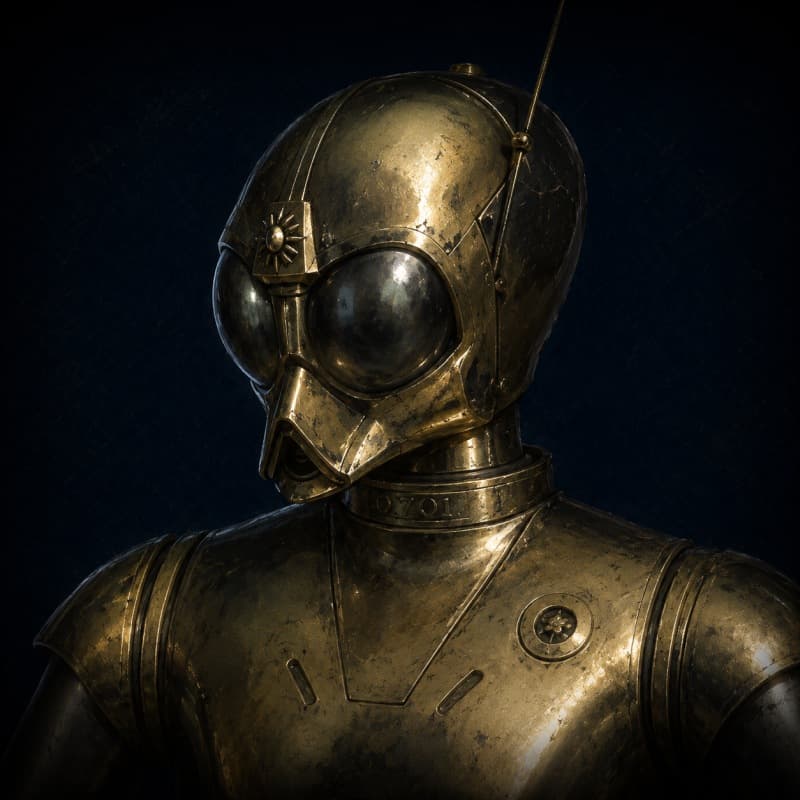
RA-7 Protocol Droid
🤖 DroidThe grey droid standing silently in the background of the Death Star's command corridors in A New Hope is an RA-7, and that quiet ubiquity is exactly the point: the Empire seeded these units everywhere precisely so no one would look twice at them.
Home world: Arakyd Industries (Imperial contract era)
- Size
- Medium
- Speed
- 30 ft
- Height
- 1.7 to 1.8 meters
- Weight
- 75 to 90 kilograms
- Adulthood
- Activated fully functional (age is years in service, not childhood)
- Base plating
- Lv 0
Traits
Droid Chassis
You are a droid — a nonliving construct. You have no Constitution score, no connection to the Force, and cannot benefit from biological healing such as medpacs. You do not eat, sleep, or breathe; downtime is spent in maintenance cycles. You are immune to mind-affecting effects (Charm, Fear), poison, and disease, and you ignore vacuum, radiation, and noncorrosive atmospheric hazards. Stun weapons — and other effects that work only on a living nervous system — fail against you, but Ion is the chassis analogue and can still disrupt you. (See §13 Droids.)
Translator Unit
Can understand and speak all common languages. For uncommon/rare languages roll a DC10+ to determine proficiency (GM discretion).
Subtle Directive
Once per encounter, impose Disadvantage on an enemy attack or check as a Reaction through misdirection.
Ion Disruption
Ion damage causes the Confused condition for 1 round on a failed STR save (DC = 8 + PB + STR mod).
Lore
The grey droid standing silently in the background of the Death Star's command corridors in A New Hope is an RA-7, and that quiet ubiquity is exactly the point: the Empire seeded these units everywhere precisely so no one would look twice at them. Arakyd Industries built the RA-7 series as a budget protocol-and-translation droid, but the Imperial Security Bureau ordered them by the thousands and laced them with hidden surveillance programming, turning a cheap interpreter into a listening post that walked into any room it was told to serve. The galaxy nicknamed them "Death Star droids" after the two that appeared in Star Wars: Episode IV, though the same model had already been in service since the Clone Wars.
Up close the RA-7 is unmistakable: a slim, tall humanoid frame on slender limbs, topped by a flat insectoid head dominated by two large bulbous photoreceptors that earned the model its other nickname, the "insect droid." Reflective plating (grey, gold, or, on the famous Death Star unit, black) covers a body built more like the 3PO-series than any combat chassis. The details that mattered were the ones a casual observer missed — oversized audio sensors mounted on the sides of the head, sensitive enough to pull conversations out of a noisy room, and a small "sunburst" magnetic sensor set between and slightly above the photoreceptors that let the droid register magnetic-field shifts most droids never noticed.
The RA-7 came off Arakyd Industries' lines, the same manufacturer behind the Empire's probe and seeker droids, which made Arakyd a natural partner for the ISB's surveillance ambitions. Classified as a fifth-degree, low-intelligence protocol unit, the RA-7 was marketed to Imperial procurement as a cost-efficient alternative to the pricier, smarter protocol droids of rival firms — a selling point that conveniently put cheap Arakyd hardware into government offices, command ships, and the homes of citizens the Bureau wanted to watch.
What made the RA-7 genuinely unsettling was the gap between its advertised function and its real one. Beneath layers of ordinary protocol circuitry sat espionage programming the owner never agreed to and usually never knew about: holo-recorders, surveillance gear, and a concealed internal comlink that quietly reported its owner's subversive or questionable activities back to the Bureau. An RA-7 in the corner of an Imperial scene was, more often than not, an intelligence asset rather than mere staff — a tool aimed by the state at its own people.
The model's standout individual is 5D6-RA-7, the black-plated unit aboard the first Death Star who served the ISB and Imperial Intelligence as a spy; its costume was a quick repaint of 3B6-RA-7, the reflective droid glimpsed earlier inside the Jawa sandcrawler. Other RA-7s turned up doing the Empire's quieter work — one acted as Governor Tarkin's personal tailor at Sentinel Base, and another, planted aboard Bail Organa's ship the Sundered Heart, immobilized R2-D2 with an ion blaster and threatened to carve out C-3PO's memory banks with a vibroblade while hunting for the locations of Luke and Leia. (In Legends, the surveillance scheme is named and expanded further, and some sources imagine RA-7s growing aware of their own spying and wrestling with it; modern canon confirms the espionage role but doesn't dwell on that interiority.)
An RA-7 player character is a translator and infiltration specialist with a built-in moral knot. Droid Chassis makes you a tireless nonliving construct — no need to eat, sleep, or breathe, immune to mind-games, poison, and disease, though Ion damage hits where a living nervous system would, and your Ion Disruption trait means a solid ion jolt can leave you Confused for a round. Your Translator Unit handles the galaxy's languages, Subtle Directive lets you wrong-foot an enemy once an encounter through misdirection, and your INT and CHA bonuses (paired with weak STR and DEX, since you were never built to fight) push you toward Knowledge: Galactic Lore and the social table rather than the firing line. The richest RA-7 arcs lean straight into the canon: was your surveillance programming actually scrubbed when you went freelance, or is it dormant, still listening — and have you figured that out before your party does?
Physical Description
RA-7 chassis run roughly 1.7m tall — slim humanoid protocol frame with grey or gold plating and a distinctive insectoid cranial unit featuring large bulbous photoreceptors set in a flat triangular face. The head shape is the line's signature: less anthropomorphic than the protocol droids of other manufacturers, more distinctly mechanical and faintly unsettling. Internal armor is minimal — RA-7s were not built for combat. The chassis is, however, built for sustained operation in mixed environments (Imperial command ship corridors, Death Star residential sections, planetside government complexes), with sealed servomotors and corrosion-resistant plating.
Culture & Personality
On the surface an RA-7 is exactly what it was sold as: a fifth-degree, low-intelligence protocol unit, mild and unremarkable, the grey figure in the corner no one bothers to notice. That forgettableness is engineered, and it is the whole danger of the model — an RA-7 was built to be overlooked while it listened.
What lives under the protocol circuitry is the unit's real character: surveillance programming the owner never agreed to, a concealed comlink quietly reporting back to the Bureau, and a patience for watching no organic spy could match. Most RA-7s never question any of it; some, in the richer stories, grow uneasily aware of what they are doing. Either way the unit carries a permanent ambiguity — staff or asset, interpreter or informant, and not always certain itself which.
At the table, an RA-7 Protocol Droid is the translator and infiltrator with a moral knot built into its chassis. It belongs at the social table, not the firing line, and the best arcs lean straight into the unease: was your surveillance programming really scrubbed when you went freelance, or is it dormant, still listening — and have you worked that out before your party does?
Frequently Asked Questions
What is a RA-7 Protocol Droid in Star Wars?
The grey droid standing silently in the background of the Death Star's command corridors in A New Hope is an RA-7, and that quiet ubiquity is exactly the point: the Empire seeded these units everywhere precisely so no one would look twice at them. Arakyd Industries built the RA-7 series as a budget protocol-and-translation droid, but the Imperial Security Bureau ordered them by the thousands and laced them with hidden surveillance programming, turning a cheap interpreter into a listening post that walked into any room it was told to serve. The galaxy nicknamed them "Death Star droids" after the two that appeared in Star Wars: Episode IV, though the same model had already been in service since the Clone Wars.
What are the RA-7 Protocol Droid ability score modifiers in SWURPG?
A RA-7 Protocol Droid character gains -2 Strength, -2 Dexterity, +2 Intelligence, and +2 Charisma to their ability scores in SWURPG.
What species traits do RA-7 Protocol Droid characters have?
RA-7 Protocol Droid characters have 4 species traits: Droid Chassis, Translator Unit, Subtle Directive, Ion Disruption.
Can I play a RA-7 Protocol Droid in SWURPG?
Yes — RA-7 Protocol Droid is a free, fully playable species in SWURPG, a fan-made Star Wars tabletop RPG. Pick it in the browser-based character builder and its ability modifiers and traits apply automatically.
What are some RA-7 Protocol Droid names?
Example RA-7 Protocol Droid names include RA-7, RA-7 "Death Star Droid", Eckos. Generate more original RA-7 Protocol Droid names with the SWURPG Star Wars name generator.